
 Google Play
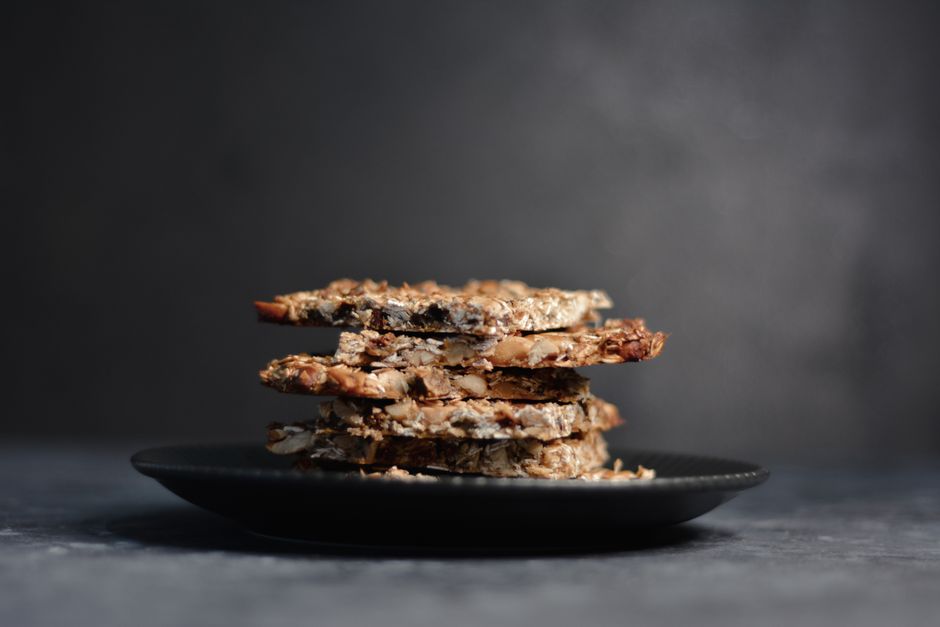
Granola bars might be the single most successful health-halo food on the market: oats and nuts on the front, and, on a surprising number of them, a sugar content that rivals the cookie aisle once you flip to the back.
The health food reputation
Granola bars have ridden a "wholesome" image for decades — oats, nuts, a mountain on the wrapper. Many are closer to a repackaged cookie: oats held together with a meaningful amount of sugar or syrup.
What's usually driving the sugar up
Granola needs a binder to hold its shape, and that binder is very often honey, brown rice syrup, or corn syrup in real quantity — commonly 8-15 grams of sugar in a single small bar, more in bars with chocolate chips or a yogurt coating.
Coatings and mix-ins don't help
Chocolate chips, yogurt coatings, and dried fruit all add sugar on top of the binder, and a bar loaded with several of these can carry as much sugar as a dessert while still sitting in the "granola" aisle. That doesn't make it a bad food occasionally — it just means it's not a low-sugar snack by default.
Chewy versus crunchy: does it matter?
Chewy bars generally need more syrup-based binder to hold their soft texture together, while crunchy or baked bars can rely more on the oats themselves plus a smaller amount of binder, which sometimes, though not always, translates into a lower sugar count. It's not a reliable rule on its own — plenty of crunchy bars are just as sugar-heavy — but it's a reasonable first guess when comparing two unfamiliar bars without time to read both labels closely.
What to look for instead
Look for a shorter ingredient list, sugar under about 8 grams, and 3 or more grams of fiber — that combination tends to separate a genuinely lower-sugar bar from a candy bar wearing an oat-and-nut costume. Checking the label takes ten seconds and tells you more than anything printed on the front of the wrapper.
Making your own
Homemade granola bars, built from oats, nuts, a modest amount of honey or maple syrup, and a binding agent like nut butter, give full control over sugar content in a way store-bought rarely does, and a basic recipe takes about the same effort as baking a batch of cookies. For anyone who eats granola bars often enough that the sugar adds up meaningfully, this is one of the more effective ways to keep the convenience while cutting the added sugar closer to a third or less of what a typical store-bought bar carries.
Protein content is usually modest
Traditional granola bars, even the ones marketed as a breakfast replacement, typically carry only 2-5 grams of protein, meaningfully less than a dedicated protein bar and not enough to provide the sustained fullness a genuine breakfast or snack built around protein would. This is worth knowing specifically because "granola bar for breakfast" is a common habit that leaves people hungry again within an hour or two, which isn't a willpower problem — it's a predictable result of a snack built mostly around refined carbohydrate and sugar rather than protein or fat.
Pairing a granola bar with a source of protein, like a hard-boiled egg or a small yogurt, closes most of that gap without requiring a different snack entirely — a simple fix for anyone who already relies on granola bars regularly and would rather adjust the pairing than change the habit.
Reading past the nut and oat imagery
Packaging featuring prominent images of whole oats, nuts, and fruit is one of the most consistent visual cues used across the entire granola bar category, regardless of what the actual ingredient list underneath says. Treating that imagery as decoration rather than information, and going straight to the nutrition panel and ingredient list, is the single most reliable habit for cutting through it — the same habit that applies to front-of-package claims on nearly every other food in this guide.
"Made with whole grain oats" is a particularly common claim worth double-checking against the ingredient list specifically, since it only requires that whole oats appear somewhere in the product — it says nothing about how much whole grain versus refined flour, sugar, or syrup makes up the rest of the bar. A bar can technically earn this claim while still being predominantly sugar and refined starch by weight.
Kids' granola bars deserve their own specific caution, since many are formulated even sweeter than the adult versions to appeal to a younger palate, often with 10 grams or more of added sugar in a single small bar aimed at a much smaller body. Checking the label on children's snack bars with the same scrutiny as any other packaged food, rather than assuming a kid-marketed product is automatically a reasonable choice, is worth the extra few seconds.